Precinct Guide
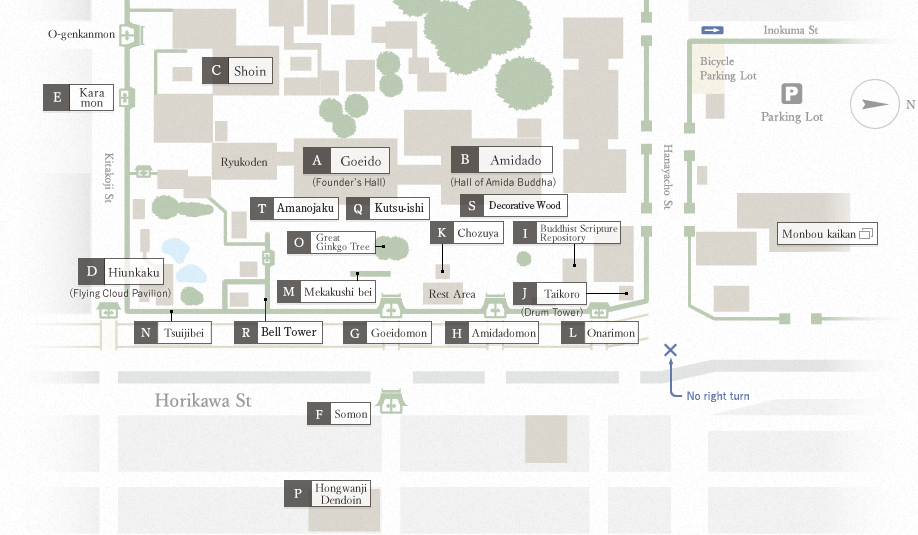
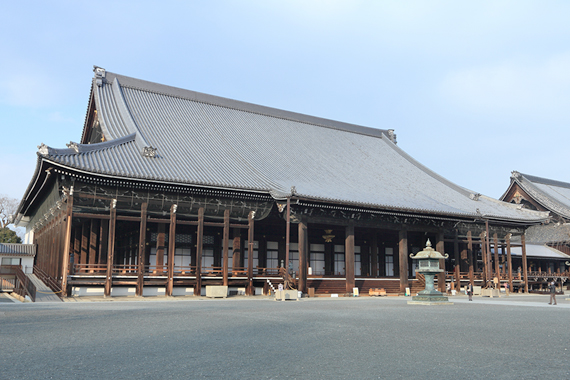
AGoeido (Founder's Hall)
National Treasure
Built in 1636. Its dimensions are 62 x 48m with a height of 29m. A wooden image of Shinran Shonin, the founder of the Jodo Shinshu teaching, is enshrined in the central altar. The position of Monshu, Head Priest of our religious organization, has been assumed by successors in the founder's lineage. Portraits of successive Head Priests are displayed along the sides of Shinran's image.
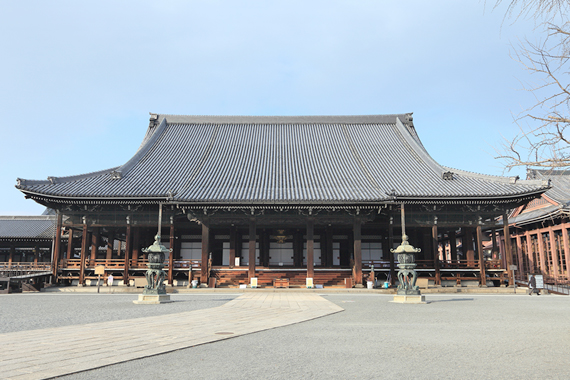
BAmidado (Hall of Amida Buddha)
National Treasure
Built in 1760. Its dimensions are 45 x 42m and stands 25m tall. In the central altar is a wooden image of Amida Buddha, flanked by portraits of six of the Seven Pure Land Masters: Nagarjuna and Vasubandhu (India), Tanluan, Taocho and Shandao (China), and Genshin (Japan). In the side alcoves are portraits of Shinran's direct teacher Honen (left) and one of the first patrons of Japanese Buddhism, Prince Shotoku (right).
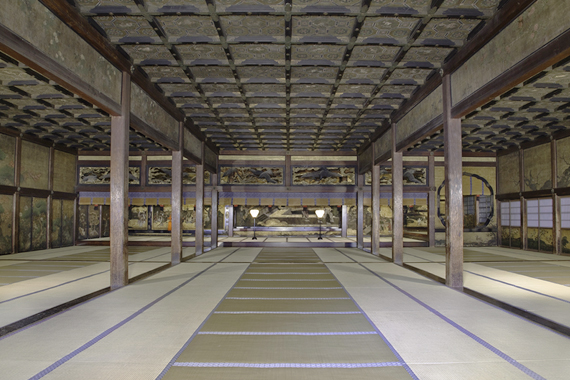
CShoin
National Treasure
The Hongwanji Shoin consists of chambers richly decorated with wall and screen paintings of exceptional quality, those of which architectural and art style mostly dating from the late 16th century. The Shoin complex is roughly divided into two parts: Taimensho or Main Audience Hall, and Shiro Shoin or Suite of three decorative chambers. Located to the west of the Main Audience Hall are several auxiliary chambers, such as the Chamber of Sparrows, Wild Geese Chamber, and Chrysanthemum Chamber. It is not ordinarily open to the public.
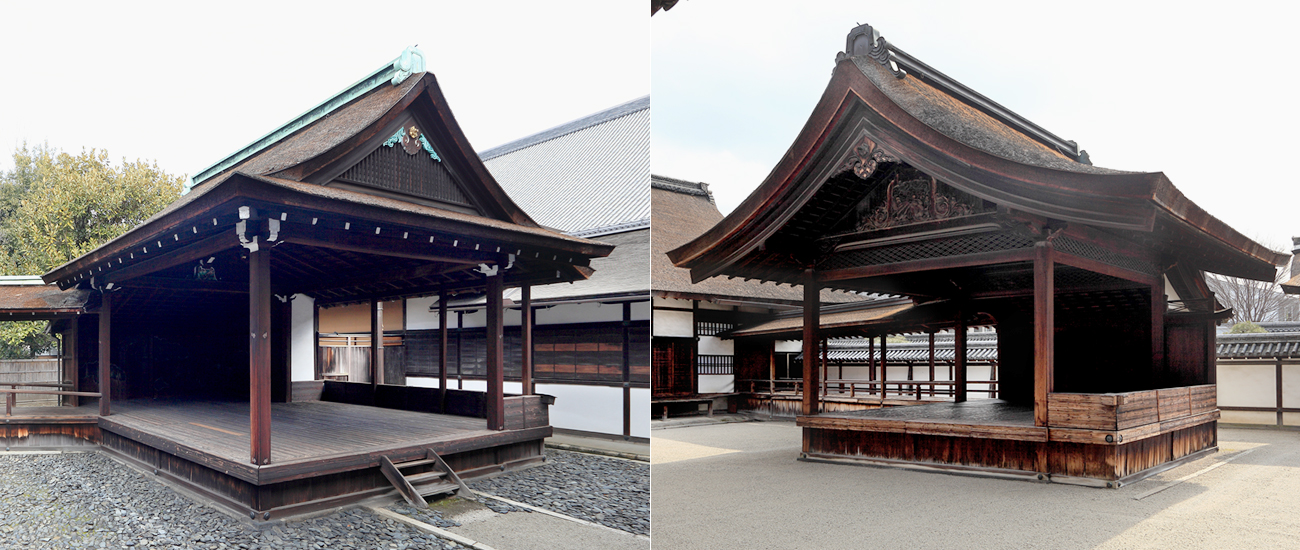
CNoh Stages
National TreasureImportant Cultural Asset
Hongwanji has two outdoor Noh stages. The North stage, located in the courtyard north to the Shiro Shoin, is the oldest surviving Noh stage in Japan and has been designated as a National Treasure. On the other hand, an Important Cultural Asset, the South stage facing the south end of the Main Audience Hall is the venue of Noh plays performed annually to celebrate the birthday of the Jodo Shinshu founder, Shinran Shonin. Neither is ordinarily open to the public.
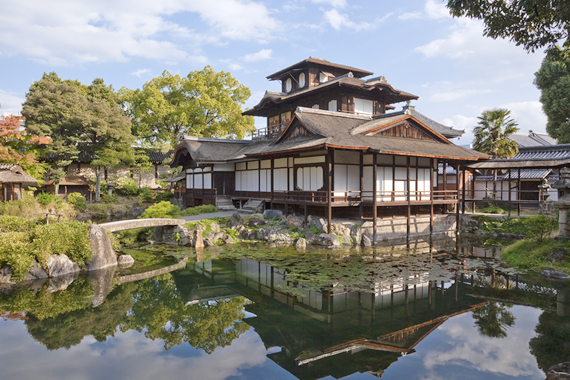
DHiunkaku (Flying Cloud Pavilion)
National Treasure
This three-story building is praised as one of the three noted pavilions in Kyoto along with Kinkaku or Golden Pavilion, and Ginkaku or Silver Pavilion. It is not ordinarily open to the public.
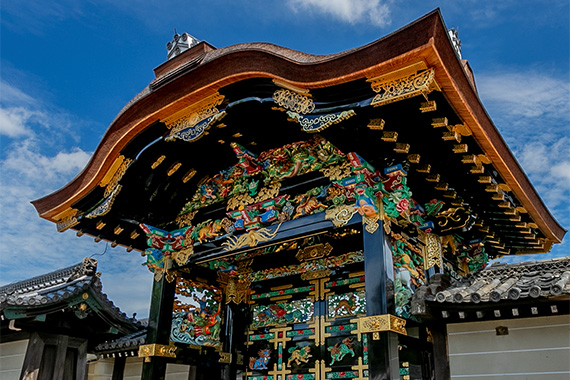
E Karamon
National Treasure
This four-pillared gate protected by a cypress-thatched Chinese-style gable is known as the "All day gate," saying that one could lose track of time and spend an entire day admiring its lavishly decorative carvings. It was made applying characteristics from late 16th century Japanese architecture.
FSomon
Important Cultural Asset
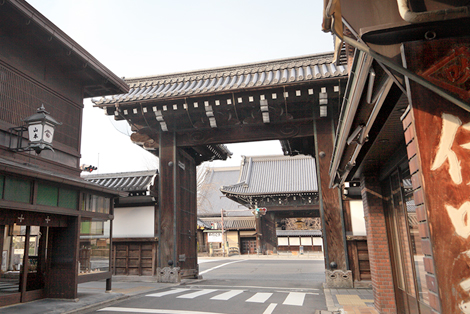
This gate was relocated three times. The first relocation was done when the 450th Memorial for Rennyo Shonin* was conducted in 1898, and in 1911 it was shifted again when the 650th Memorial for Shinran Shonin was observed. For the latest, in 1959, upon request from the city of Kyoto, the gate was moved to the present site when Horikawa Street was expanded in accordance with increase of the traffic of the road. On its curved beams sit a pair of large kaerumata.** Prior to its designation as an Important Cultural Asset, the gate was renovated in 2011.
*Rennyo Shonin (1415-1499): The 8th Shushu (Head Priest) of Hongwanji who accomplished a dramatic expansion in temple's congregation.
**kaerumata: Ornamental wooden carvings located on crossbeams of Japanese traditional architecture.
GGoeidomon
Important Cultural Asset
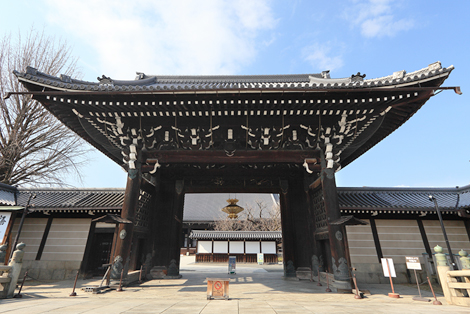
Although the exact construction year is unknown, a record shows that the gate was repaired in 1859 by a kosha* based in Osaka. In 1960, prior to the 700th Memorial for Shinran Shonin, the gate went through another renovation. For three years between 2006 and 2009, along with the restoration of the Tsuiji wall,** partial repair work such as, stonework, reroofing, and replacement of metal parts, of a variety of Hongwanji structures were conducted. On that occasion, many of the Goeidomon's roof tiles were replaced, however, some of the old tiles are still used on its south roof.
*kosha: 講 ko (lit., "lecture") originally refers to a gathering for listening to Buddhist lectures, and it later came to signify a group of people who appreciate the same teaching. In the context of the Jodo Shinshu community, 講社 kosha specifies an officially designated group of people who support Hongwanji in a variety of ways, such as donations in kind or volunteer activities.
**Tsuijibei wall: See "Tsuijibei" presented below in this list.
HAmidadomon
Important Cultural Asset
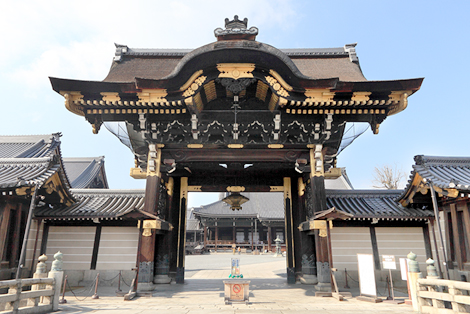
On the occasion of the Amidado restoration that was carried out over the several years in the late 1980s, partial rethatching and repair work of metal parts and gold leafing of the Amidadomon were also conducted. During the latest Goeido restoration (1999-2009), along with the Tsuijibei wall, minor restoration of the Amidadomon was also made.
IBuddhist Scripture Repository
Important Cultural Asset
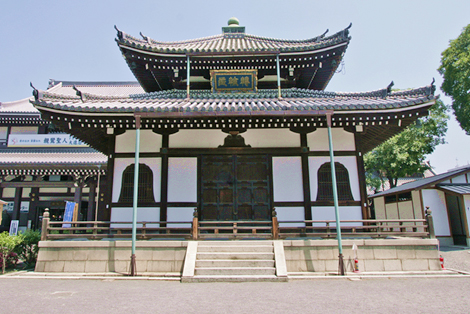
Built in 1678, contains the entire collection of the Tenkai Edition of the Daizokyo Buddhist texts. The collection is named after Tenkai, a monk of the Tendai sect who compiled the texts over a period of 12 years beginning in 1635. The following year, Hongwanji purchased the whole set of scriptures in 1648 from the Tokugawa government for approximately 100 kilograms of silver during the tenure of Hongwanji's 13th Head Priest, Ryonyo.
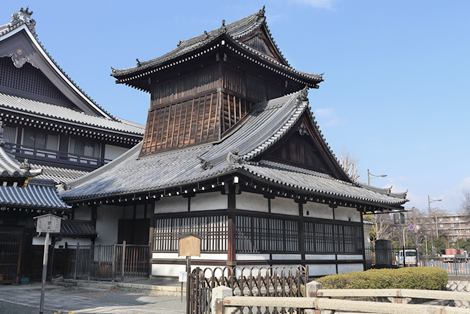
JDrum Tower
Important Cultural Asset
During the Edo period (1603-1867), the drum contained in the structure was struck signifying the time of day. This multiple-storied building situated in the northeastern corner of the Hongwanji precinct is believed to have once been used by the Shinsengumi, the armed police force organized by the feudal government at the end of the Edo period.
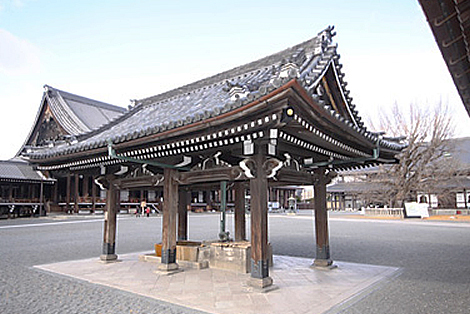
KChozuya
Important Cultural Asset
The place to wash hands. A large stone basin is set on the ground paved with square granite stones. The tiled roof over the basin is supported with six square pillars whose edges are elaborately trimmed. Along with the golden metal ornament placed on the diagonal bracing of the ceiling, decorative wooden beams inserted between the pillars add grandness to the structure. On its ceiling, wooden boards are jointed together without having a rib between them, and so it is called kagami tenjo or "mirror ceiling." Renovated in 2010.
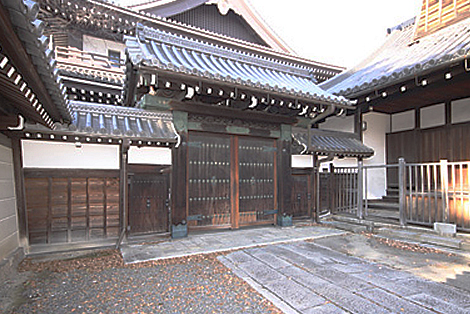
LOnarimon
Important Cultural Asset
The Onarimon gate is topped with a tiled roof in the shape of a book laid face down. On the sides of the main gate, attached are slightly lower walls. The gate is assumed to be constructed in the late 18th or the early 19th century.
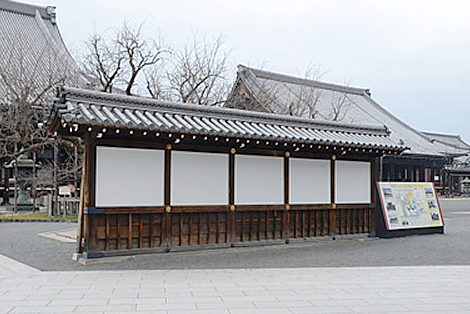
MMekakushibei
Important Cultural Asset
Mekakushibei literally means "screen wall," which is often built to block the pedestrians' view into such places as Buddhist temples, Shinto shrines, and large landowner's residences. The wall consists of a wooden dado and shikkui or plastered screen, which is topped with a tiled roof in the shape of a book laid face down. Assumed to be constructed in the late 18th or the early 19th century.
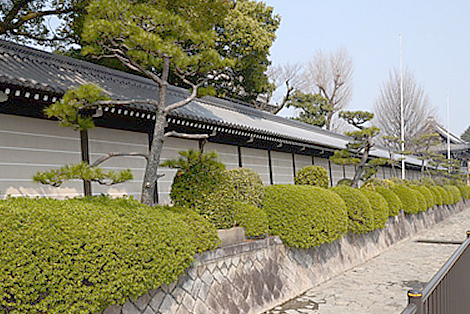
NTsuijibei
Important Cultural Asset
The mud wall that has a wooden board in its core is topped with a tiled roof in the shape of a book laid face down. On the surface of the wall, there are five horizontal lines, which were originally used by temples whose head priest was an imperial descendant, however it is not applicable to Hongwanji. Because of that origin though, the number of the lines on wall symbolizes the status of the temple and the highest number is five. Assumed to be constructed in the late 18th or the early 19th century.
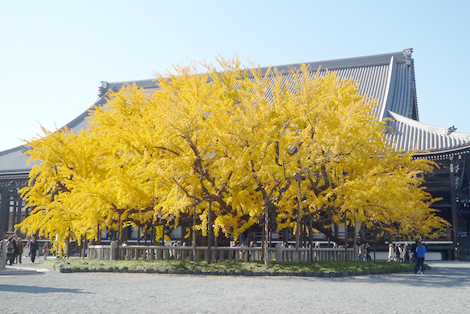
OGreat Ginkgo Tree
Estimated to be more than 400 years old, this splendid tree has been designated as a Natural Monument by Kyoto city. With its branches appearing as though they are roots spreading up into the sky, it is sometimes referred to as an "upside-down ginkgo." Legend also has it that the tree spouted out water in attempting to save the temple halls from catching on fire, so it is also called "the water-spraying ginkgo."
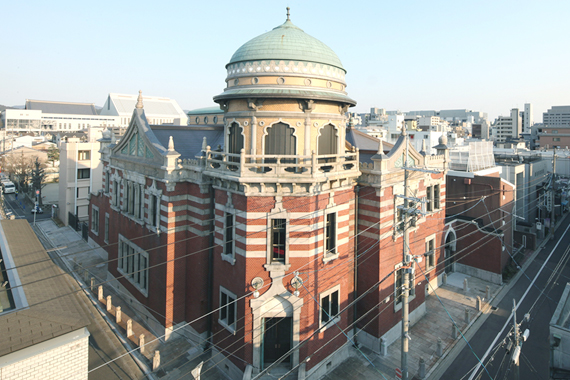
PHongwanji Dendoin
Important Cultural Asset
This collaborative piece of art designed by the famous architect ITO Chuta, was originally built in 1895 as the main office of the Jodo Shinshu Follower's Life Insurance Company. After being used for different purposes, one of which was the Research Center of the Jodo Shinshu Hongwanji-ha Buddhist organization, in 1958 the first floor of the building was renovated to be used as a Hongwanji-affiliated infirmary, Asoka Clinic. After the clinic moved out, it has become the Hongwanji Dendoin, literally meaning a facility for propagation, where Hongwanji priests come to further their studies. This brick building went through a 2-year restoration from 2010 to 2011.
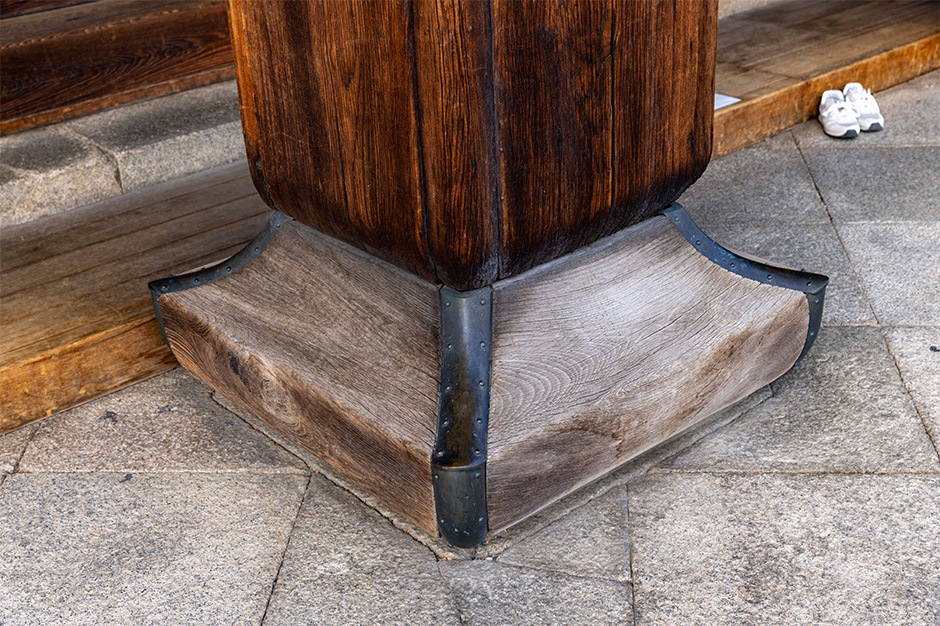
QKutsu-ishi (Shoe stones)
"Stone" or "Wood"?
Kutsu-ishi (also referred to as ne-ishi (base stones) or hashira-ishi (pillar stones)) are stones that support pillars or veranda posts. Although looking like wood, they are actually stones set in wooden covers, and therefore, are called Kutsu-ishi. Originally, they were made of pomegranate wood. In the late Edo period, during the Founder's Hall's restoration on the occasion of the 600th memorial for Shinran Shonin, the wooden bases were replaced with stone because wood could decay. It is said that the surfaces were then covered with wood, about 3 cm thick, in order to preserve Hongwanji's original appearance.
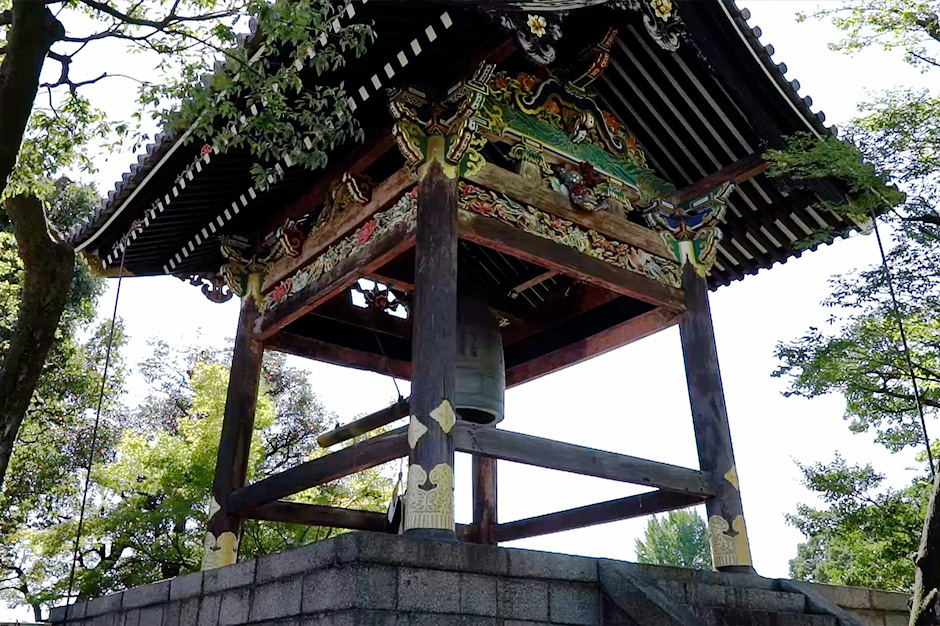
RBell Tower Important Cultural Asset
Resplendid in full color
Together with the National Treasure Hiunkaku Pavilion, the bell tower stands in the Tekisui-en Garden that is located at the south-east corner of the Hongwanji precincts. Constructed in 1618, the bell tower has been designated an Important Cultural Property. The bell is tolled to announce Buddhist services, and to this day is rung 30 or 60 minutes before services. The original bell inscribed with "Kyūan 6 (1150)" as its production year was purchased from Kōryū-ji Temple in Uzumasa, Kyoto in 1547. The bell was moved together with Hongwanji when it was relocated from Osaka to Wakayama, then again to Kaizuka and Temma, before eventually returning to Kyoto. The original bell is displayed in the south-west corner of the temple's rest area. The second-generation bell that hangs in the tower today was donated in 1996 by the Hongwanji Lay Supporters Association, who also financially supported the full color restoration of the tower in 1998.
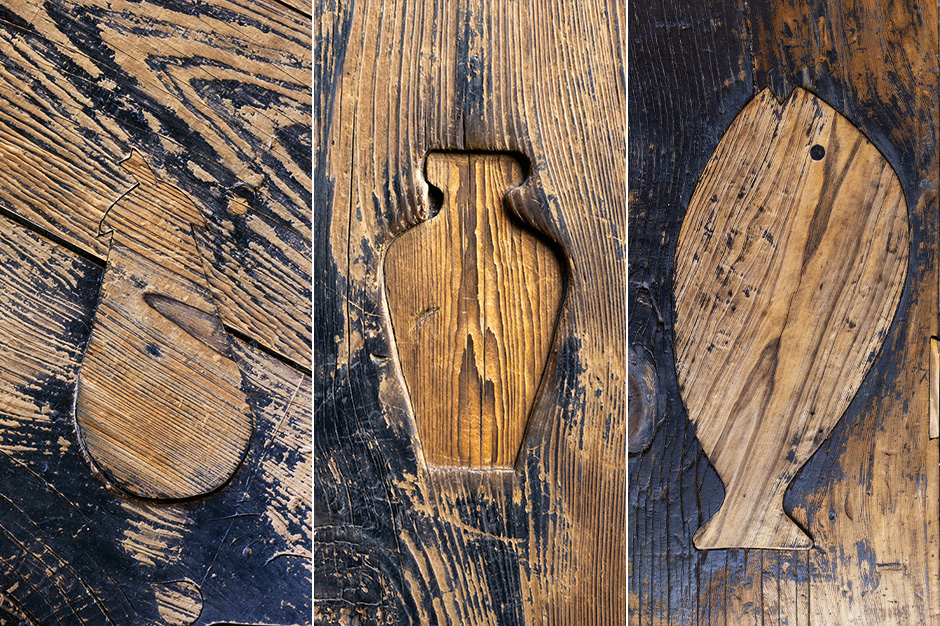
SDecorative wood repairs across the verandas and corridors
Carpenter's playful touch
Umeki refers to reinforcement or repair of cracks or holes on wooden structures by filling them with fitted wooden pieces. Many examples of this technique can be found across the verandas and corridors that bridge between Hongwanji's Founder's Hall and Amida Hall. Countless visitors pass by without noticing them, but if you take time to look closely, you may discover wood repairs or umeki (lit., 'buried wood') in a variety of shapes, such as fish, eggplants, and everyday objects like sake flasks. These inlays are more than simple repairs, but embody the playful spirit of the carpenters who crafted them with ingenuity. They also suggest their deep care for these historic halls.
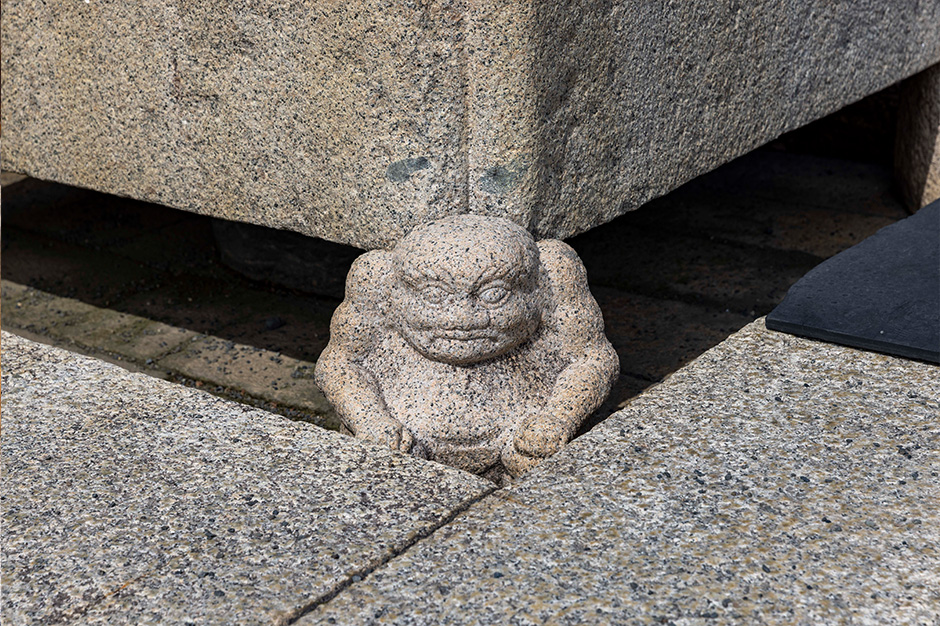
TAmanojaku (Demon-like creature)
Charming Supporters
The north and south ends of the Founder's Hall's overhang roof is connected with water pipes that lead to 150 cm-square water basins placed below. These square water receivers are supported by eight demon-like figures each of which squats under the four corners of each water basin. They are known as amanojaku. Though only about 38 cm tall, these figures are distinguished by their oversized heads, measuring roughly 15 cm high and 17 cm wide, giving them a compact, almost two-headed proportion. Each figure strikes a different pose -- some rest their hands on their knees, while others press their hands together before their chests -- creating expressions full of charm and personality. They have supported the basins continuously since the Founder's Hall was rebuilt in 1636 (Kan'ei 13), quietly carrying out their role for nearly four centuries. Amanojaku are often times seen as a nuisance. Here at Hongwanji however, they have been supporters of the Dharma, shouldering the water basins into which the 'Dharma rain' flows.